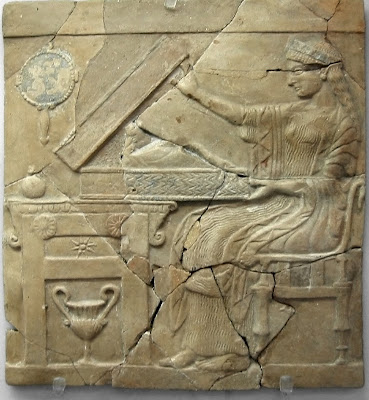
Pinax [ votive tablet ] of Persephone opening the “Liknon Mystikon”. Found in the holy shrine of
Persephone at Locri in the district Mannella. Locri was part of Magna Graecia and is situated on the
coast of the Ionian Sea in Calabria in Italy.
derivation of name | wikipedia :
In a Linear B (Mycenean Greek) inscription on a tablet found at Pylos dated 1400?1200 BC, John
Chadwick reconstructs the name of a goddess *Preswawho could be identified with Persa, daughter of
Oceanus and finds speculative the further identification with the first element of Persephone.
Persephonē (Greek: Περσεφόνη) is her name in the Ionic Greek of epic literature. The Homeric form of
her name is Persephoneia (Περσεφονεία,Persephonēia). In other dialects she was known under variant
names: Persephassa (Περσεφάσσα), Persephatta (Περσεφάττα), or simply Korē (Κόρη, “girl, maiden”).
Plato calls her Pherepapha (Φερέπαφα) in his Cratylus, “because she is wise and touches that which
is in motion”. There also the formsPerifona (Πηριφόνα) and Phersephassa (Φερσέφασσα). The existence
of so many different forms shows how difficult it was for the Greeks to pronounce the word in their
own language and suggests that the name has probably a pre-Greek origin.
Location: Soprintendenza Per I Beni Archeologici Museo Nazionale Di Locri, 89044 Locri, Province of
Reggio Calabria, Italy