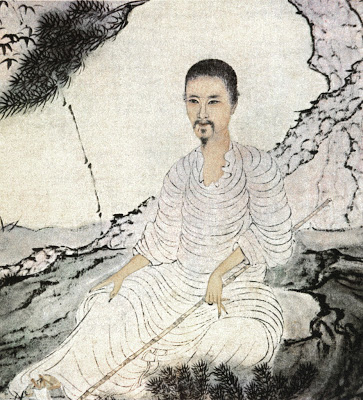
Shi Tao, Master Shi Planting Pines, c. 1674, ink and color on paper
Comments on painting Shi Tao :
One stroke method
(In the beginning there were no rules. When primeval naivete dispersed, rules took place. What were rules based upon? ONE,* the origin of beings, the base of changes, the power god applied, the ability man was endowed with but unaware of.**)
In the beginning there are no rules. When one’s naivete disperses, rules take place. What are rules based upon? ONE STROKE, the root of forms, the power the extraordinary applied, the ability the ordinary are endowed with but unaware of. How do rules take place? Awakening from within the self, one stroke grows into being and expands into rules.
Mountains, rivers and figures in riotous profusion; birds, beasts and plants of different character; water-side pavilions and towers of varying sizes – these are what painters take to heart. If a painter is unable to grasp the essence of form for a delicate expression, he must have been ignorant of this one stroke. As a journey begins with a single step, a painting, whatever it is about, begins with a single stroke; millions upon millions of brush strokes may follow, but it must end with one stroke, regardless of the when and why. If a painter takes such a stroke as the point of departure, he is unquestionably bound for success.
Without the wrist suspended the movement may not be free; without free movement the strokes may not be to one’s liking. Raise the wrist to be ready; turning the wrist to start; swing the wrist to finish a stroke. Push a stroke in checking motion; pull a stroke in lifting motion. Square-ended or round-ended, straight or curved, distorted or symmetric, tortuous or plain, wet or dry, brush strokes must be natural revelation. These rules, efficacious and time-tested, are the perfect avenues to the nature of forms and to the success of all expressions. Having chosen particular forms, pondered over and over for significance, decided the tone of a spectacle, gone over what in front and behind, with a single deft stroke, a painter produces vividly mountains, rivers, figures, birds, beasts, plants, water-side pavilions, or towers. Without any trace of affectation, such a stroke answers right his purpose.
When ONE STROKE takes place, all things can be defined. Therefore, I say, ?My doctrine is about one.?***
* Laozi, Way of Life, 42. Life, when it came to be, bore one. One bore two; two bore three; three bore all things.
** The Platform Sutra of Sixth Patriarch of Zen, Chapter One. He who sees from himself is the man, inspiration, Buddha.
*** The Analects of Confucius, Part Four. Master said, ?Sen, my doctrine is about one.? Disciple Zeng Sen replied, ?Yes.? When master was out, other disciples came up, asking, ?What do his words mean?? Zeng then said, ?His doctrine is about loyalty and forgiveness, that’s all.?
Location: National Palace Museum, Taipei, Taipei City, Taiwan 11143