 |
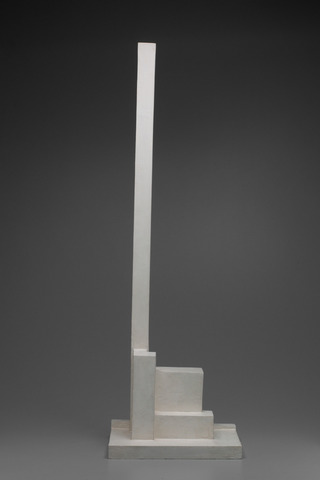 |
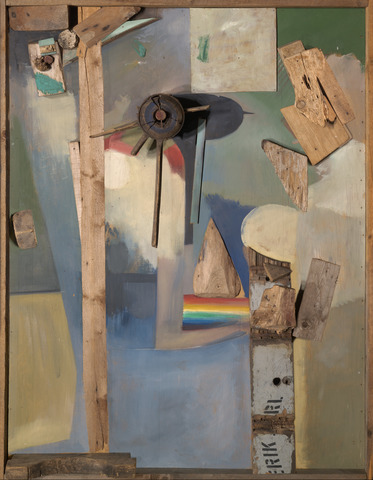
| left : Merzbild mit Regenbogen (Merz Picture With Rainbow) | 1920–39 | Yale University Mixed media on plywood – 156.5 x 121.3 x 26.7 cm (61 5/8 x 47 3/4 x 10 1/2 in.) right : Monument to the Artist’s Father | ca. 1922-1923 | Yale University |
|
Category: the beautiful
Gandhara Buddha

Buddha Shakyamuni | Pakistan, Gandhara region | 1-2 century | Los Angeles County Museum of Art
Rubens

Rubens | Voyage of the Cardinal Infante Ferdinand of Spain from Barcelona to Genoa in April 1633, with Neptune Calming the Tempest | 1635 | 64.1 x 48.9 cm | Harvard / Fogg
Titian
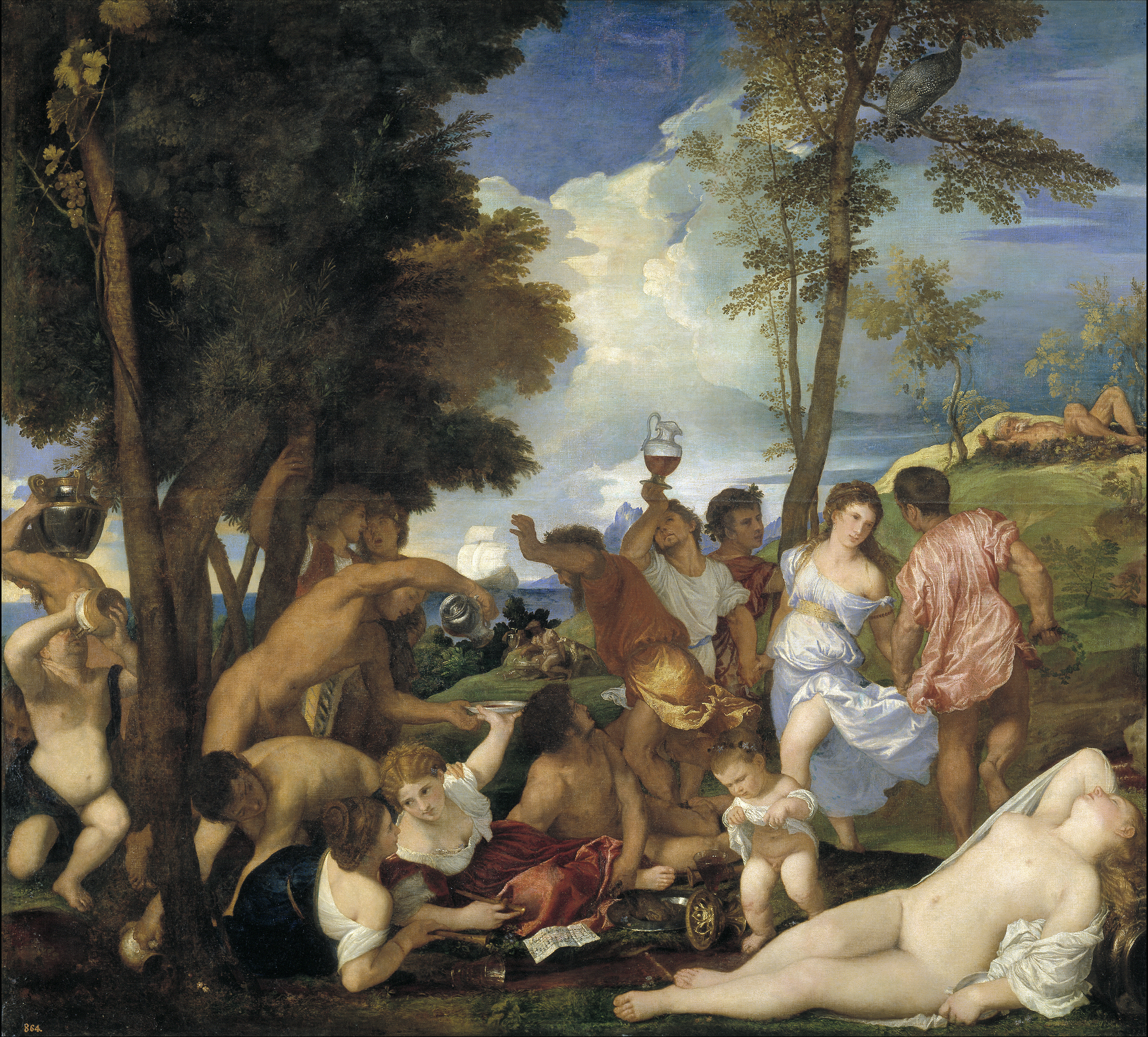
Titian | Bacchanal of the Andrians | 1523-24 | Oil on canvas 175 x 193 cm | Museo del Prado, Madrid
Cézanne : Bathers
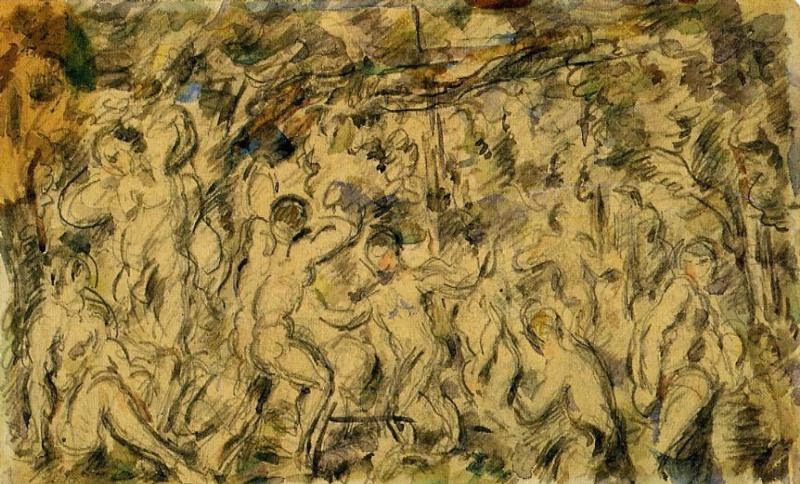
Cézanne | Bathers | c1890 | Bridgestone Museum of Art, Tokyo
Cézanne : The Battle of Love
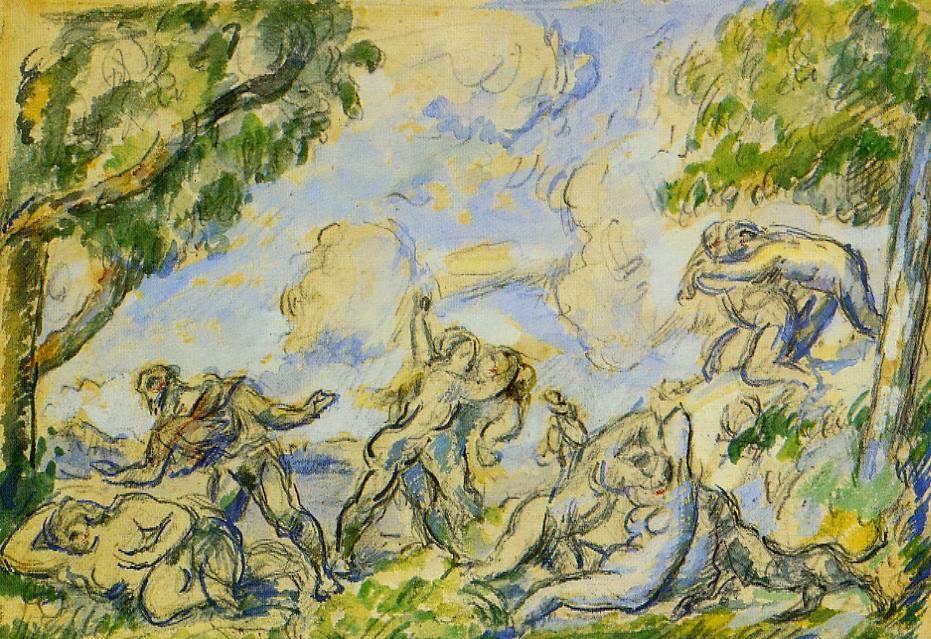
Cézanne | The Battle of Love | 1875-1876
head of a Bodhisattva

Head of a Bodhisattva
Peshawar
Gandhara period 3rd century-5th century
Lime composition with traces of polychrome
V&A London
Evolution of Hindu-Arabic numerals

Guge
 |
|
A row of Guge stupas near Tholing, in the tenth-century Kashmir-informed style, 2009 D [ Bendak//Peter van Ham ] |
 |
|
Temple room in Dungkar Cave 1, one of four caves that were residences of the Guge dynasty beginning in the twelfth century [ M. Beck/Peter van Ham ] |
Peter van Ham’s Guge: Ages of Gold. The West Tibetan Masterpieces has just been published by Hirmer Verlag.
See also this very nice article.
place of origin all of the characters in Homer’s Iliad

By Pinpin [GFDL or CC BY-SA 3.0], via Wikimedia Commons
Les Grandes Baigneuses – Cezanne
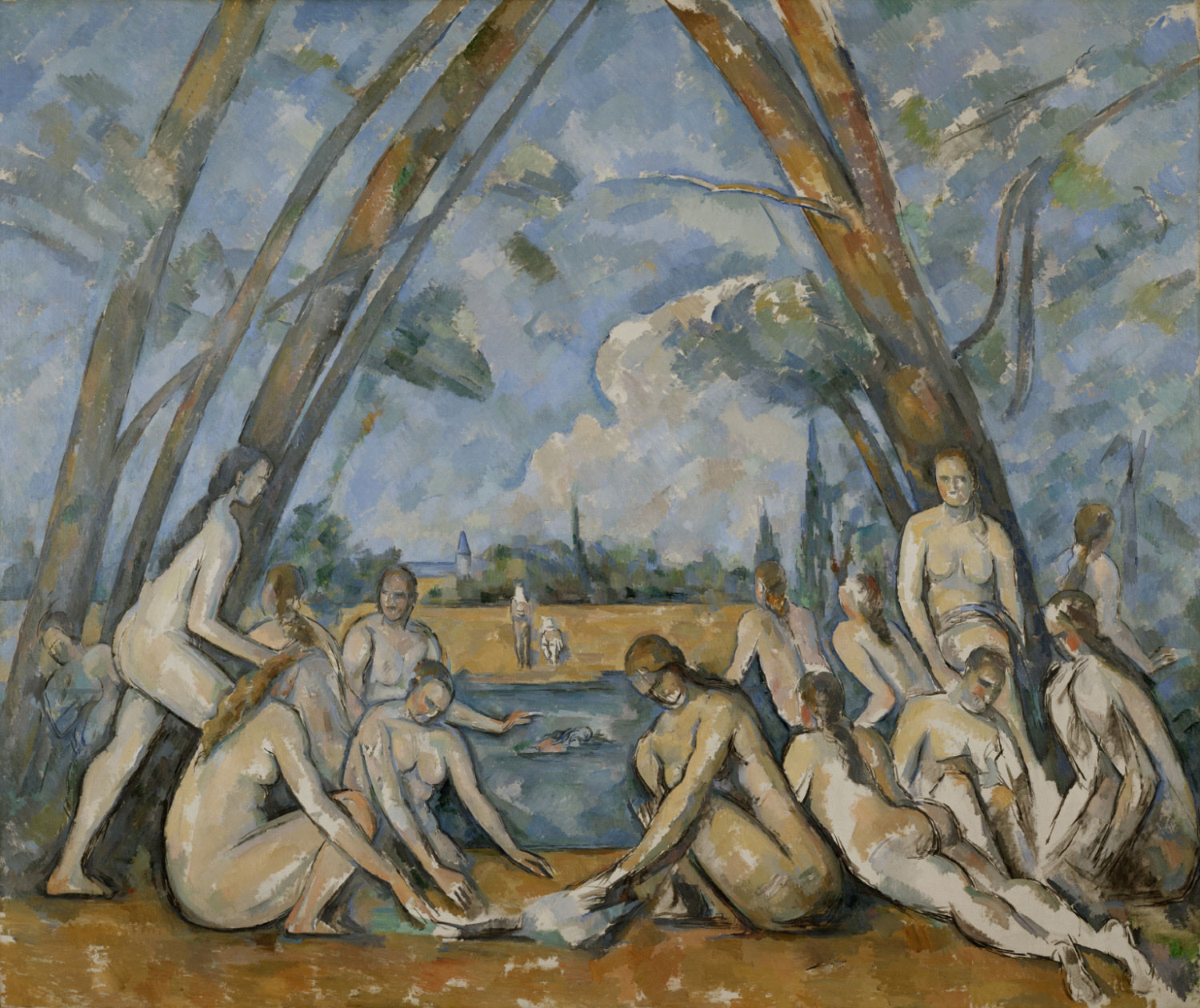 |
| Les Grandes Baigneuses | 1900-1906 | 210.5 × 250.8 cm | The Philadelphia Museum of Art |
 |
| Les Grandes Baigneuses | 1894-1905 | 127.2 x 196.1 cm | The National Gallery [ London ] |
 |
| Les Grandes Baigneuses | 1895–1906 | 132.4 x 219.1 cm | The Barnes Foundation |
Standard Model of particle physics written in the Lagrangian
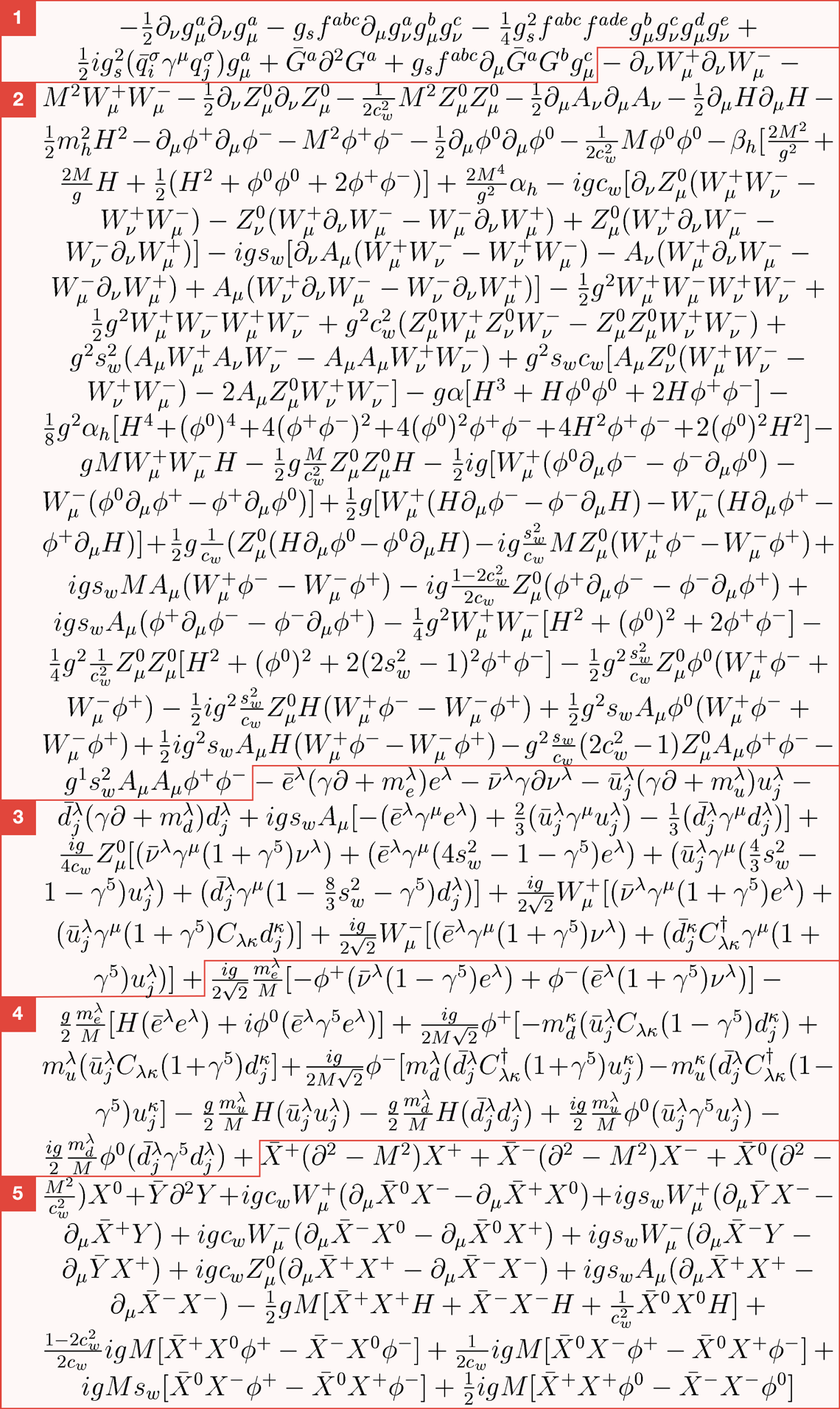
Section 1
These three lines in the Standard Model are ultraspecific to the gluon, the boson that carries the strong force. Gluons come in eight types, interact among themselves and have what’s called a color charge.
Section 2
Almost half of this equation is dedicated to explaining interactions between bosons, particularly W and Z bosons.
Bosons are force-carrying particles, and there are four species of bosons that interact with other particles using three fundamental forces. Photons carry electromagnetism, gluons carry the strong force and W and Z bosons carry the weak force. The most recently discovered boson, the Higgs boson, is a bit different; its interactions appear in the next part of the equation.
Section 3
This part of the equation describes how elementary matter particles interact with the weak force. According to this formulation, matter particles come in three generations, each with different masses. The weak force helps massive matter particles decay into less massive matter particles.
This section also includes basic interactions with the Higgs field, from which some elementary particles receive their mass.
Intriguingly, this part of the equation makes an assumption that contradicts discoveries made by physicists in recent years. It incorrectly assumes that particles called neutrinos have no mass.
Section 4
In quantum mechanics, there is no single path or trajectory a particle can take, which means that sometimes redundancies appear in this type of mathematical formulation. To clean up these redundancies, theorists use virtual particles they call ghosts.
This part of the equation describes how matter particles interact with Higgs ghosts, virtual artifacts from the Higgs field.
Section 5
This last part of the equation includes more ghosts. These ones are called Faddeev-Popov ghosts, and they cancel out redundancies that occur in interactions through the weak force.
Thomas Gutierrez, an assistant professor of Physics at California Polytechnic State University, transcribed the Standard Model Lagrangian for the web. He derived it from Diagrammatica, a theoretical physics reference written by Nobel Laureate Martinus Veltman. In Gutierrez’s dissemination of the transcript, he noted a sign error he made somewhere in the equation.
in Symmetry
Cézanne
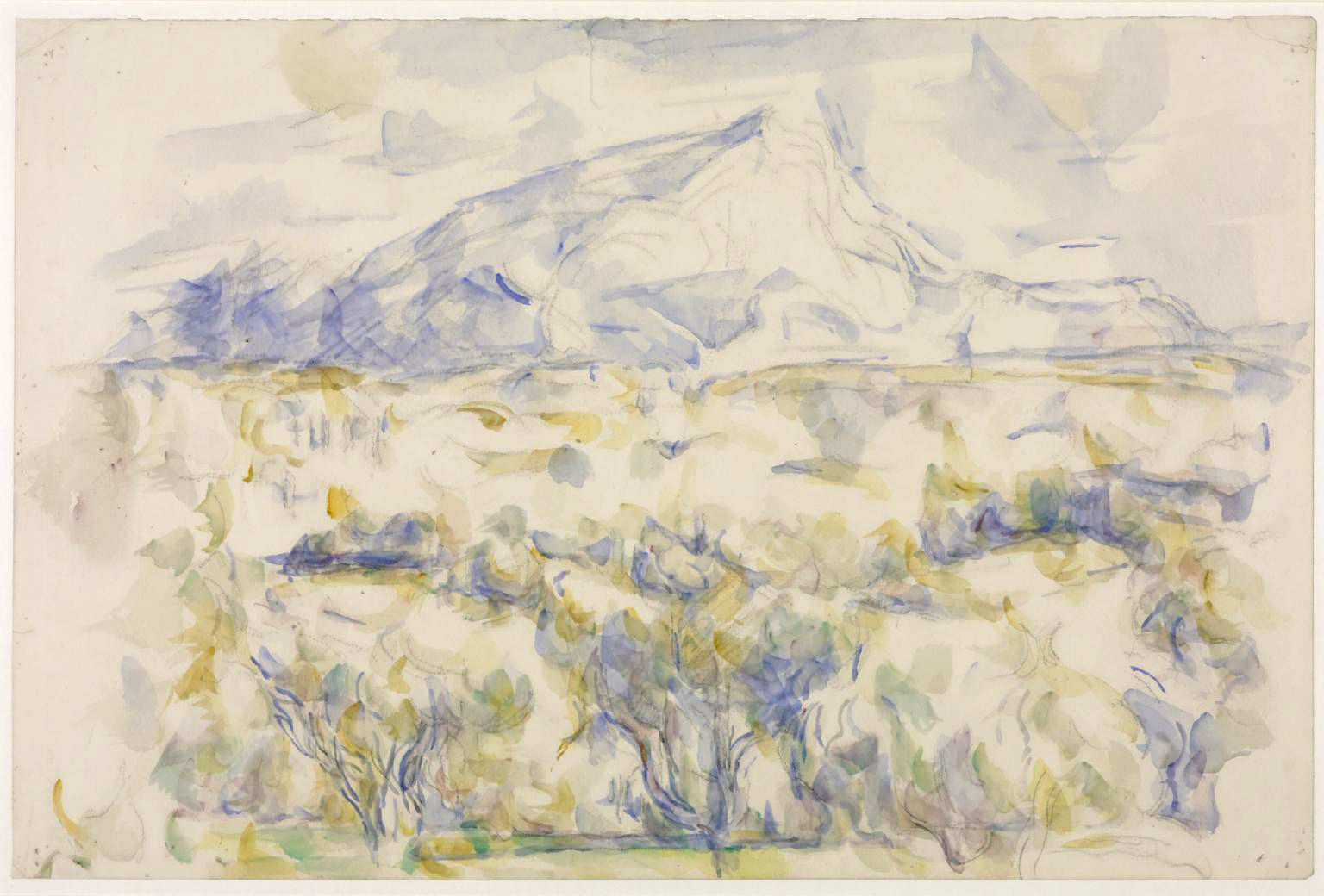
“Le principal dans un tableau est de trouver la juste distance. La couleur avait à exprimer toutes les ruptures dans la profondeur. C’est la qu’on reconnaît le talent d’un peintre.” – Cézanne
Paul Cézanne [ 1839–1906 ] | Montagne Sainte Victoire [ 1905–06 ]
Watercolour on paper 362mm x 549 mm | Tate Gallery [ Bequeathed by Sir Hugh Walpole 1941 ]
Orfeo
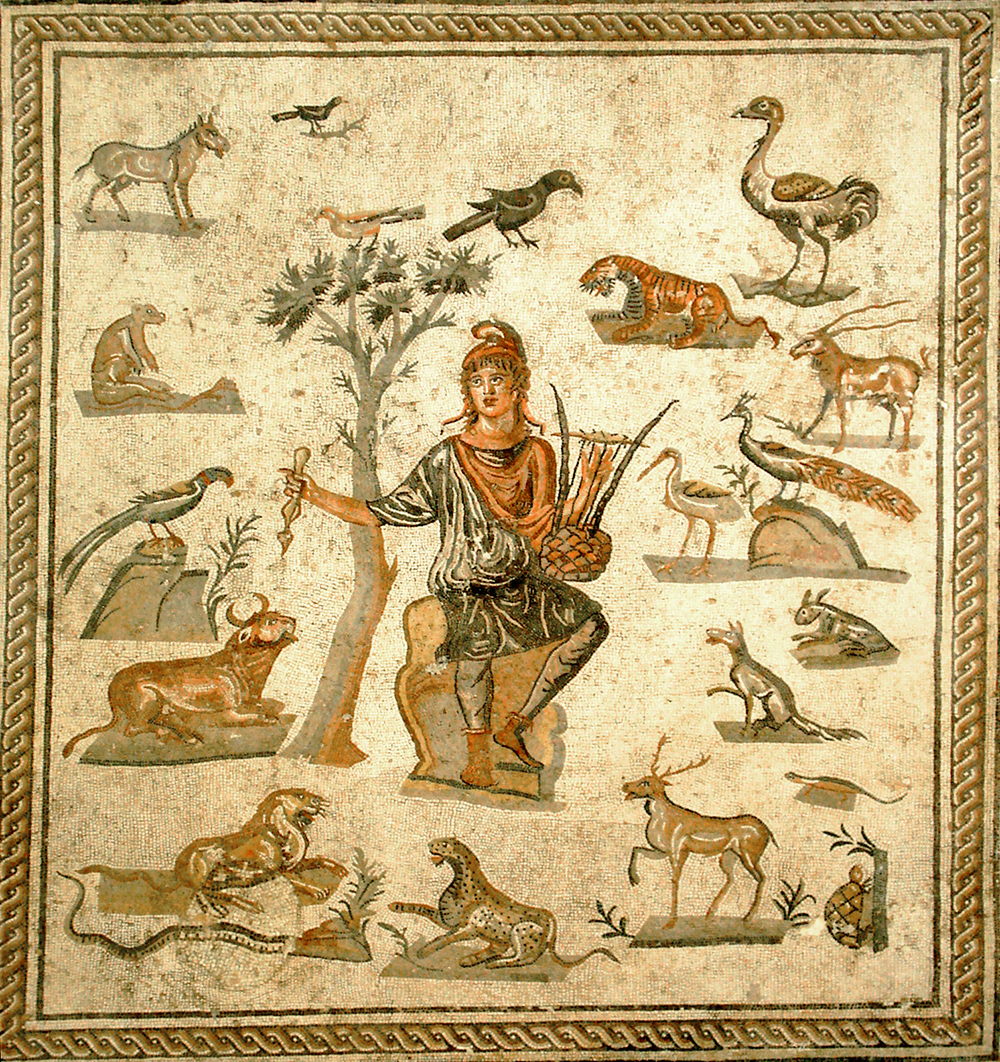
Orpheus surrounded by animals. Ancient Roman floor mosaic, from Palermo, now in the Museo archeologico regionale di Palermo. Picture by Giovanni Dall’Orto.
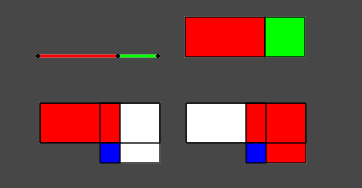
Euclid

One of the oldest [ca. 75-125 A.D] and most complete diagrams from Euclid’s Elements of Geometry is a fragment of papyrus found among the remarkable rubbish piles of Oxyrhynchus in 1896-97 by the renowned expedition of B. P. Grenfell and A. S. Hunt. It is now located at the University of Pennsylvania. The diagram accompanies Proposition 5 of Book II of the Elements, and along with other results in Book II it can be interpreted in modern terms as a geometric formulation of an algebraic identity – in this case, that ab + (a-b)2/4 = (a+b)2/4
“If a straight line be cut into equal and unequal segments, the rectangle contained by the unequal segments of the whole together with the square on the straight line between the points of section is equal to the square on the half.” (from the classic translation of T. L. Heath)