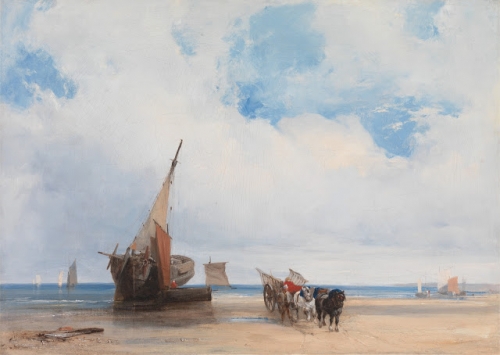
Bonington

ba-obj-1287-0003-pub-large


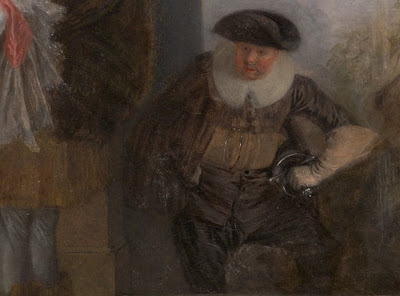
Richard Parkes Bonington 1802-1828

Beached Vessels and a Wagon, near Trouville, France
Oil on canvas ca. 1825
Dimensions 14 5/8 x 20 5/8 inches (37.1 x 52.4 cm)
Yale Center for British Art, Paul Mellon Collection Accession Number B1986.29.1

the Brygos Painter

an00083169_001_l

an00593401_001_l_detail


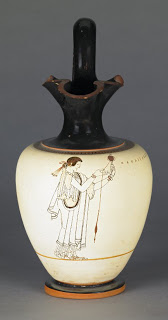
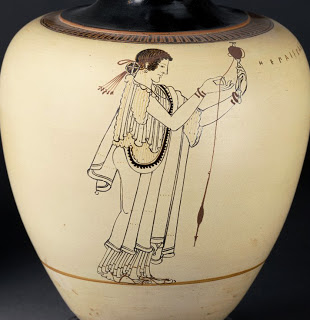
Pottery: White-ground oinochoe.

A woman in a long sleeved, dotted chiton, a bordered himation, and sandals, with earrings, bracelets, and hair wound into a ball on the neck and fastened with a fillet, standing to right, twisting between the thumb and first finger of her right hand a thread from a hank of wool on a distaff which she holds up with her left. On the right, HEΠAIΣ KAΛΕ, ή παΐς καλή. The neck, handle, and foot are glazed black; the surface of the neck is slightly raised above that of the shoulder. The edge of the lip is coloured purple; at the base of the handle is an inverted palmette below a strip of egg pattern, and below the moulding on the shoulder is a band of tongue pattern; all red on black. The body is covered with a white engobe, on which the design is drawn in black outline. Purple is used for fillet, bracelets, sandals, wool, and spindle. Light brown for inner markings and upper folds of chiton and inscription. The hair is drawn in dark brown lines on a wash of light brown. Eye archaic. Below, a thin brown line.

490BC-470BC (circa)

BM Registration number : 1873,0820.304

Kudung Zhugbul

8809022119_eab26c2cbf_c


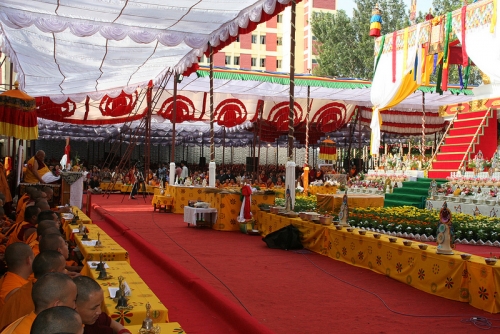
On 23 May 2013, an assembly of more than 10,000 attendees gathered
before the Cremation Stupa for the Holy Body of HH Drubwang Pema Norbu
Rinpoche.

The prayers began at 5 AM with senior lamas leading as follows:

His Holiness Taklung Tsetrul Rinpoche lead prayers in Zangdokpalri.

His Holiness Khyentse Yangsi Rinpoche and HH Karma Kuchen Rinpoche in
the Phurba Temple

His Eminence Tulku Thubsang Rinpoche in the Tara Temple

His Eminence Yangthang Rinpoche in the Shedra Temple

Guests and devotees began arriving as early 6 AM to find a seat under
huge tents raised for the occasion. At 8 AM, the processional
commenced, and the Kudung was taken from the location on the second
floor of Zangdokpalri Temple to the Cremation Stupa. The processional
arrived at about 9 AM and was taken from the box in which it had
remained the past four years.

Our senior lamas took their seats in the four directions around the
Cremation Stupa as follows:

To the South was His Holiness Taklung Tsetrul Rinpoche, the Supreme
Head of the Nyingma School and with a group of monks recited the
Thubje Chenpo practice.

To the West was His Holiness Khyentse Yangsi Rinpoche, throne holder
of Shechen Monastery, and incarnation of His Holiness Dilgo Khyentse
Rinpoche, a close friend to His Holiness Pema Norbu Rinpoche. His
Holiness Karma Kuchen Rinpoche sat by HH Khyentse Rinpoche and with
the assembled monks were praying the Dor Sem (Vajrasattva).

To the North was His Eminence Tulku Thubsang Rinpoche carrying through
the prayers of Palchen Dupa with assembled monks.

To the East was His Eminence Yangthang Rinpoche, reciting Shitro Nyen
Song Nejung with assembled monks.

The smoke arose to the sky as the fires were lit within the stupa,
bringing blessings to the entire world. May all beings benefit from
the vast and generous offerings made this holy day.

Location: Bylakuppe, Karnataka, India

Khenchen Palden Sherab Rinpoche

164967_10151404156072686_53755276_n


“The most eminent signs of accomplishment are devotion to the master, pure perception of
Dharma brothers and sisters, compassion for sentient beings, conscientiousness in regard to
cause and effect, disenchantment with samsara, detachment from material things, a peaceful
and gentle personality, and one-pointed focus on practice. When all these grow and increase
more and more in one’s being, this alone will suffice as signs of accomplishment.”

Tsele Natsok Rangdrol

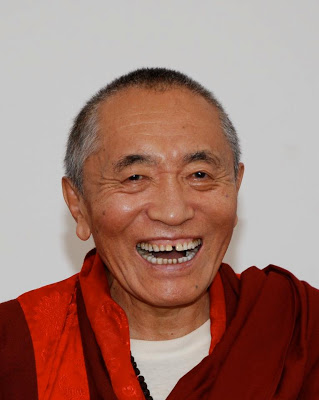
Photo of Khenchen Palden Sherab Rinpoche
Palm Beach Dharma Center, 2008

Priests of Virtue in the Kamakura Period

semuiji_myoue


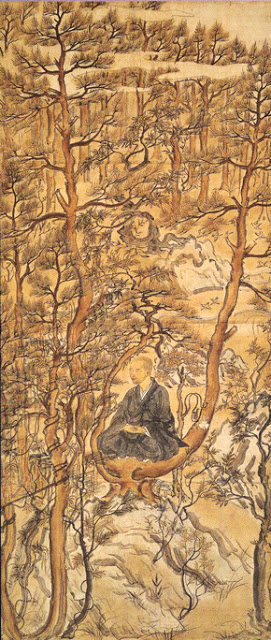
The Monk Myoe from Kozan-ji, Kyoto, dated to 13th Century Kamakura period

Hanging scroll 145.0 cm x 59.0 cm color on silk
Priests of Virtue in the Kamakura Period | special exhibition 1993 Nara National Museum

Location: Nara National Museum, Noboriojicho, Nara, Nara Prefecture 630-8213, Japan

kasaya

ps191454_l


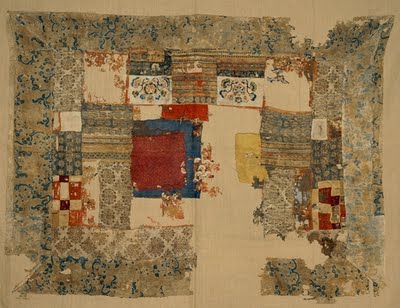
Patchwork of silk, probably a kasaya

From Cave 17, Mogao, near Dunhuang, Gansu province, China

Tang Dynasty, 8th-9th century AD

A Buddhist monastic robe : Height: 1070.000 mm : Width: 1490.000 mm

British Museum annotation :

Sir Marc Aurel Stein originally suggested that this large patchwork was an altar-cloth, though it has now been identified as a kasaya, a Buddhist monastic robe. The symmetrical arrangement of patches along a central vertical axis is consistent with the prescribed form for a kasaya. Even though these patches of cloth were originally meant as a sign of humility, a splendid array of silks has been used in this example.

The patchwork comprises seven vertical columns of fabric enclosed by a border of plain silk printed with blue foliated scrolls. Within the border are woven or printed silks with a rosette design. The dominating floral motif embroidered in the centre has largely disintegrated, revealing the silk patches used for strengthening. Only two small white panels of floral embroidery still remain intact.

The magnificence of the materials used and the presence of purple suggest that the wearer must have been a priest of high rank. Hong Bian (active in the mid-ninth century), the head priest who is commemorated in the cave where these textiles were found, had been given the right to wear purple by the emperor. Small pieces of purple silk were also found inside his statue.

M. Aurel Stein, Serindia: detailed report of e, 5 vols. (Oxford, 1921)
R. Whitfield, Art of Central Asia: The Stein, vol. 3 (Tokyo, Kodansha International Ltd., 1982-85)
R. Whitfield and A. Farrer, Caves of the thousand Buddhas: (London, The British Museum Press, 1990)

Location: The British Museum, Great Russell Street, London Borough of Camden, London WC1B 3DG, UK
Pondicherry interpretation

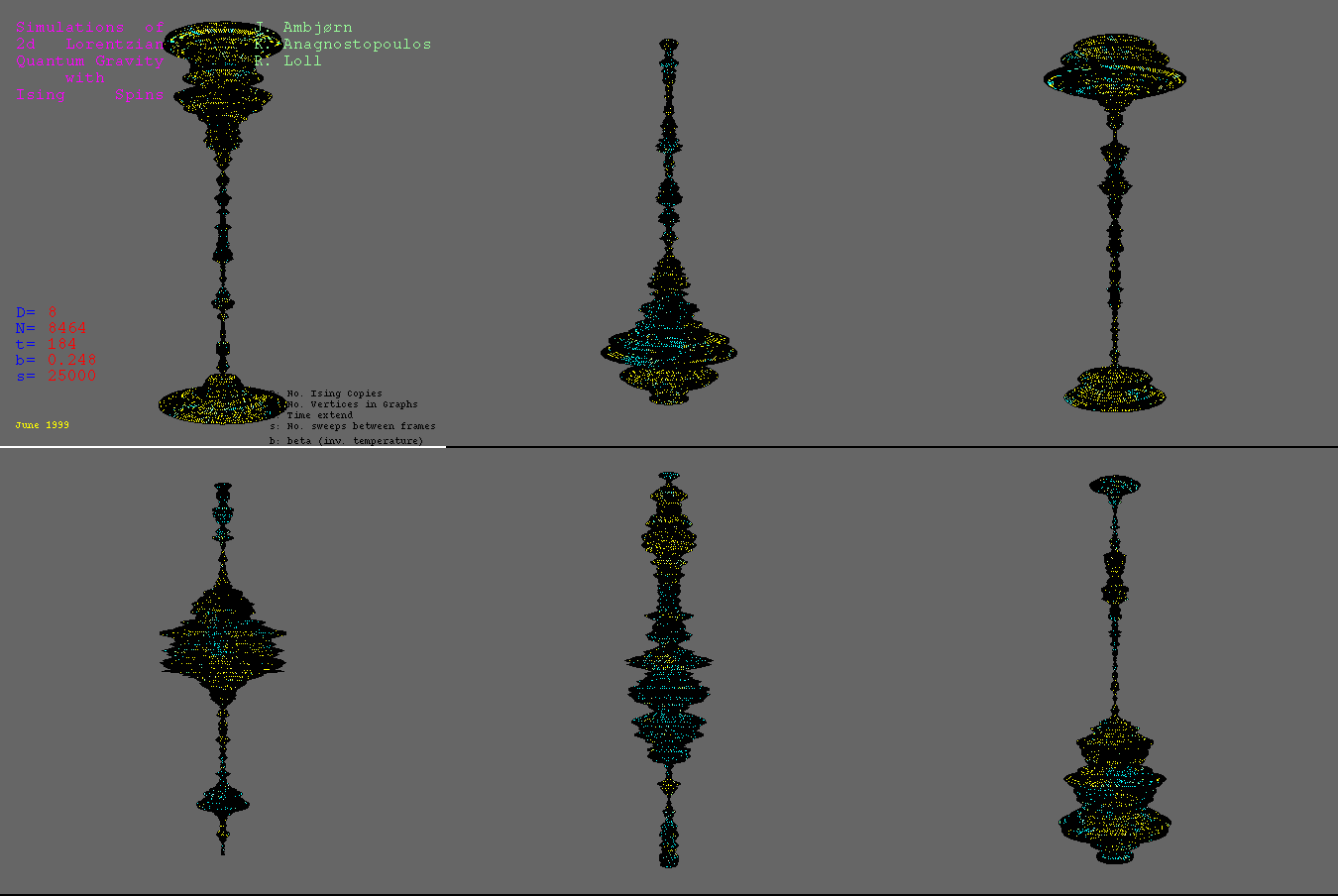
An overview of the Pondicherry interpretation of quantum mechanics is presented.
This interpretation proceeds from the recognition that the fundamental theoretical
framework of physics is a probability algorithm, which serves to describe an
objective fuzziness (the literal meaning of Heisenberg?s term ?Unschärfe,? usually
mistranslated as ?uncertainty?) by assigning objective probabilities to the possible
outcomes of unperformed measurements. Although it rejects attempts to construe
quantum states as evolving ontological states, it arrives at an objective description
of the quantum world that owes nothing to observers or the goings-on in physics
laboratories. In fact, unless such attempts are rejected, quantum theory?s true
ontological implications cannot be seen. Among these are the radically relational
nature of space, the numerical identity of the corresponding relata, the incomplete
spatiotemporal differentiation of the physical world, and the consequent top-down
structure of reality, which defies attempts to model it from the bottom up, whether
on the basis of an intrinsically differentiated spacetime manifold or out of a multitude
of individual building blocks.

full arXiv text : The Pondicherry interpretation of quantum mechanics: An overview

U. Mohrhoff
Sri Aurobindo International Centre of Education
Pondicherry 605002 India

most excellent – thank you

Self-arising Primordial Awareness

Within the essence of ultimate truth, [yang dag don gyi ngo bo la]
    there is no buddha or ordinary being. [sangs rgyas dang ni sems can med]
Since awareness cannot be reified, it is empty. [rig pa ‘dzin pa med pas stong]
Given that it does not dwell in emptiness, [stong pa nyid la me gnas na]
    it abides in its own state of supreme bliss. [rang gi bde chen sa la gnas]
The majestic ruler of all buddhas [sangs rgyas kun gyi rje btsan pa]
    is understood to be one’s own awareness. [rang gi rig pa shes par bya]
This monarch, naturally manifest awareness, [rang snang rig pa’i rgyal po nyid]
    is present in everyone, but no one realizes it. [kun la yod de kun gyis rtog pa med]

‘Self-arising Primordial Awareness’ (Tibetan: རིག་པ་རང་ཤར་, Wylie: rig pa rang shar) is one of
the Seventeen tantras of the Dzogchen Upadesha.

wikipedia entry

Jamgön Kongtrül’s Treasury of Knowledge

all adjusted


In Tibetan religious literature, Jamgön Kongtrül’s Treasury of Knowledge in ten books stands
out as a unique, encyclopedic masterpiece embodying the entire range of Buddhist teachings
as they were preserved in Tibet. In his monumental Treasury of Knowledge, Jamgön Kongtrül
presents a complete account of the major lines of thought and practice that comprise Tibetan
Buddhism.

The Treasury of Knowledge: Book One
The Treasury of Knowledge: Books Two, Three, and Four
The Treasury of Knowledge: Book Five
The Treasury of Knowledge: Book Six, Parts One and Two
The Treasury of Knowledge: Book Six, Part Three
The Treasury of Knowledge: Book Six, Part Four
The Treasury of Knowledge: Book Seven and Book Eight, Parts One and Two
The Treasury of Knowledge: Book Eight, Part Three
The Treasury of Knowledge: Book Eight, Part Four
The Treasury of Knowledge: Books Nine and Ten

by Jamgön Kongtrül Lodro Taye translated by Kalu Rinpoche Translation Group