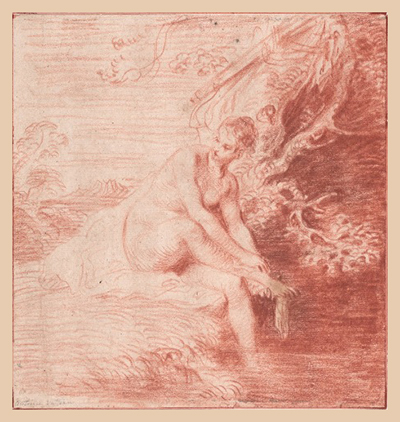
Antoine Watteau
Diana Bathing, c. 1715-1716
Albertina, Vienna
Antoine Watteau
Diana Bathing, c. 1715-1716
Albertina, Vienna
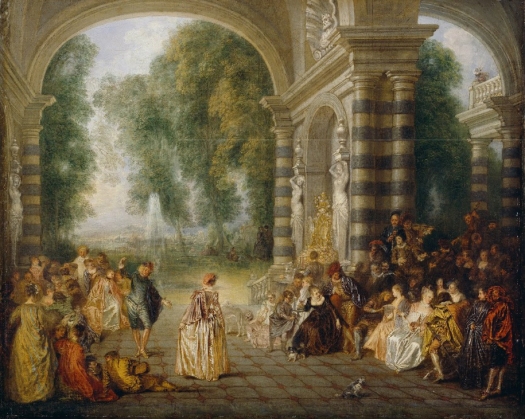
Antoine Watteau : Les Plaisirs du Bal
c. 1715-17
w652 x h525 cm
Dulwich Picture Gallery London UK
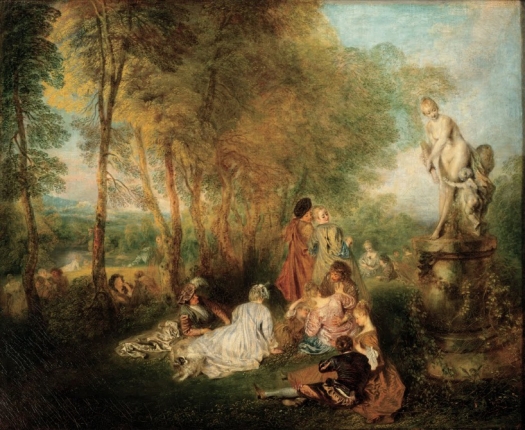
Antoine Watteau : The Feast of Love
ca 1718 – 1719
w750 x h610 cm
Gemäldegalerie Alte Meister, Staatliche Kunstsammlungen Dresden
The term Dzogchen can be translated into English in different ways: as the Great Completion, the Great Perfection and the Great Exhaustion.
It is called the Great Completion because the nature of mind is endowed with all enlightened qualities and everything is complete within it. Everything is complete within this path, within these instructions. If we relate this to our individual path and practice, then it means that our mind itself is completely awakened right from the beginning. It is full of the genuine qualities of buddhahood. There is nothing missing
It is called the Great Perfection because the nature of mind and the nature of the world is perfect from the beginning. There are no impurities in the true nature of mind. All such incidental stains are temporary. The true nature, or reality, of mind is perfect; it is inherently pure, which in Dzogchen language is called the ?primordial pure? nature. Therefore, you don?t have to look beyond or go outside of your immediate experience to find another thought or emotion that is more sacred, more pure.
It is called the Great Exhaustion because, first, from the point of view of the fruition of the path, all the mind?s impurities are exhausted and consumed; and second, from the point of view of mind?s true nature, these impurities have never had any true existence. In reality, they have no true essence. They are just the confused appearances of our thoughts. From the positive side we say they are primordially pure, and from the point of view of negation we say they are primordially nonexistent.
From Great Perfection: Outer and Inner Preliminaries by the Third Dzogchen Rinpoche, translated by Cortland Dahl, introduction by Dzogchen Ponlop.
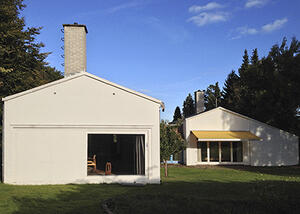
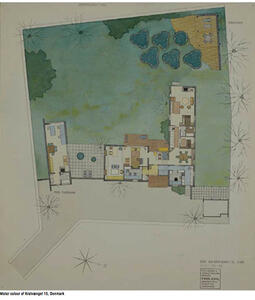
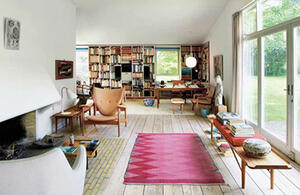
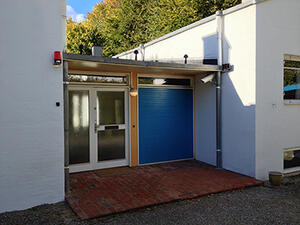
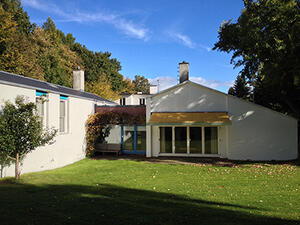
“Finn Juhl built a house at no. 15 Kratvaenget in Ordrup outside Copenhagen, together with his first wife, Inge-Marie Skaarup. It was his ambition to create a home, where he had designed every single detail him-self, and to create an overall, general look. He achieved this in 1942, when the building presented a gradual flow between different areas, rather than a collection of individual rooms.”
House as it is now does not have the left hand structure and patio as shown in sketch.
Rather incredible images of glacial calving – this clip was running today at an exhibition at the Louisiana Museum just outside of Copenhagen in Denmark.
All apparent phenomena are nothing but delusion, and there is, moreover, no freedom from delusion to be achieved by dispelling delusion. Delusion is, by its own essence, completely pure and, hence, enlightened. All phenomena are, in this way, primordially, fully, and completely enlightened. Phenomena appearing as various attributes are, therefore, indeed the mandala of vajra body, speech, and mind. They are like the Buddhas of the three times, never transcending the essence of complete purity. Sentient beings and Buddhas are not differentiated in terms of their essence. Just like distinct causes and results appearing in a dream, they are nothing but perceptions of individual minds brought forth by the power of imputation.
Establishing Appearances as Divine: Rongzom Chökyi Zangpo on Reasoning, Madhyamaka, and Purity
With regard to one?s behavior, one must relinquish all the limitations implied in subject-object duality (gzung ?dzin gyi la dor ba). One should abandon all ordinary ways of assessing outer and inner phenomena, and the engagement or withdrawal of the mind with regard to ?good? and ?bad.? One must not, through mindless clinging to sense objects, stray into the five ordinary mental poisons. For when approached with skillful means, all are but the display of the great and perfect equality.
Treasury of Precious Qualities: Book Two: Vajrayana and the Great Perfection by Jigme Lingpa, page 110 | by Longchen Yeshe Dorje, Kyabje Kangyur Rinpoche, Jigme Lingpa translated by Padmakara Translation Group
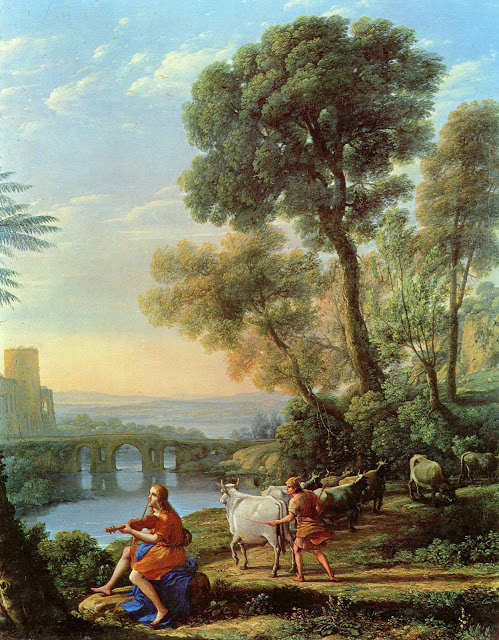
Claude Lorrain
Landscape with Apollo Guarding the Herds of Admetus and Mercury Stealing Them
circa 1645
55 cm × 45 cm
Location: Via del Corso, 305, 00186 Rome, Italy
The Exalted Discourse on the Meditative State That Gathers All Merits states : O Stainless Brilliance ! For great bodhisattvas who yearn for the teachings, the teachings’ treasures have been placed in mountains, in ravines, and in forests. Long mantras and infinite gateways to the teachings made into volumes will come into their hands.
Jamgon Kongtrul Lodro Taye : The Treasury of Knowledge: Books Two, Three, and Four page 331
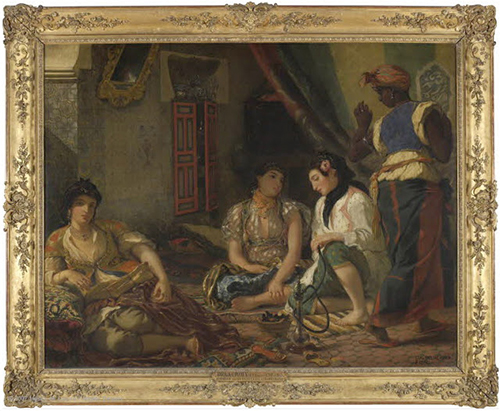
Eugène Delacroix (Charenton-Saint-Maurice (Val-de-Marne), 1798 – Paris, 1863)
Women of Algiers in Their Apartment
Salon of 1834
H. 1.80 m; W. 2.29 m
Acquired at the Salon of 1834
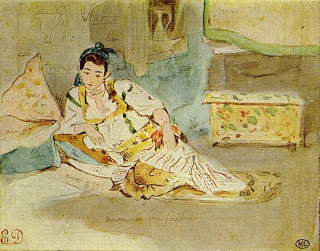

The Women of Algiers (2 studies) [ 1832 ] each 10cm × 13cm
Location: Louvre Museum, 75001 Paris, France
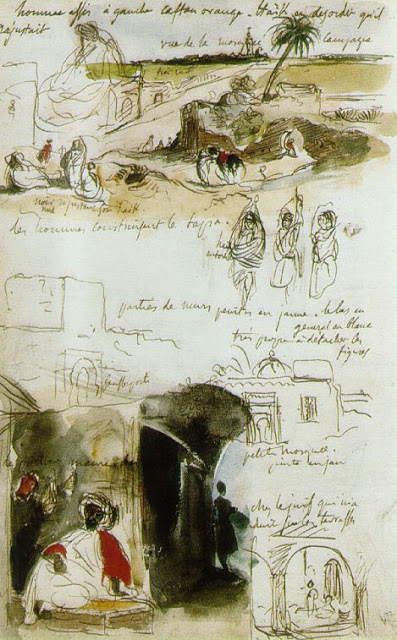
Eugene Delacroix
Moroccan notebook
1832
watercolor 19.3 x 12.7 cm
Location: Louvre Museum, 75001 Paris, France
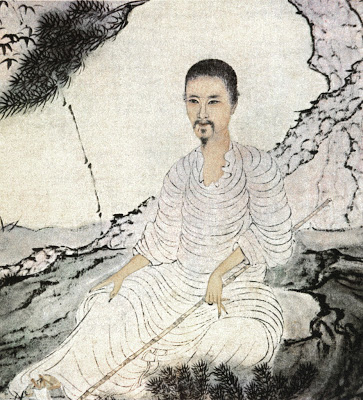
Shi Tao, Master Shi Planting Pines, c. 1674, ink and color on paper
Comments on painting Shi Tao :
One stroke method
(In the beginning there were no rules. When primeval naivete dispersed, rules took place. What were rules based upon? ONE,* the origin of beings, the base of changes, the power god applied, the ability man was endowed with but unaware of.**)
In the beginning there are no rules. When one’s naivete disperses, rules take place. What are rules based upon? ONE STROKE, the root of forms, the power the extraordinary applied, the ability the ordinary are endowed with but unaware of. How do rules take place? Awakening from within the self, one stroke grows into being and expands into rules.
Mountains, rivers and figures in riotous profusion; birds, beasts and plants of different character; water-side pavilions and towers of varying sizes – these are what painters take to heart. If a painter is unable to grasp the essence of form for a delicate expression, he must have been ignorant of this one stroke. As a journey begins with a single step, a painting, whatever it is about, begins with a single stroke; millions upon millions of brush strokes may follow, but it must end with one stroke, regardless of the when and why. If a painter takes such a stroke as the point of departure, he is unquestionably bound for success.
Without the wrist suspended the movement may not be free; without free movement the strokes may not be to one’s liking. Raise the wrist to be ready; turning the wrist to start; swing the wrist to finish a stroke. Push a stroke in checking motion; pull a stroke in lifting motion. Square-ended or round-ended, straight or curved, distorted or symmetric, tortuous or plain, wet or dry, brush strokes must be natural revelation. These rules, efficacious and time-tested, are the perfect avenues to the nature of forms and to the success of all expressions. Having chosen particular forms, pondered over and over for significance, decided the tone of a spectacle, gone over what in front and behind, with a single deft stroke, a painter produces vividly mountains, rivers, figures, birds, beasts, plants, water-side pavilions, or towers. Without any trace of affectation, such a stroke answers right his purpose.
When ONE STROKE takes place, all things can be defined. Therefore, I say, ?My doctrine is about one.?***
* Laozi, Way of Life, 42. Life, when it came to be, bore one. One bore two; two bore three; three bore all things.
** The Platform Sutra of Sixth Patriarch of Zen, Chapter One. He who sees from himself is the man, inspiration, Buddha.
*** The Analects of Confucius, Part Four. Master said, ?Sen, my doctrine is about one.? Disciple Zeng Sen replied, ?Yes.? When master was out, other disciples came up, asking, ?What do his words mean?? Zeng then said, ?His doctrine is about loyalty and forgiveness, that’s all.?
Location: National Palace Museum, Taipei, Taipei City, Taiwan 11143
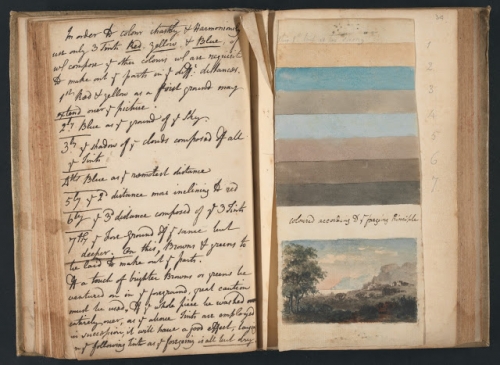
William Gilpin (1724-1804), Hints to form the taste & regulate ye judgment in sketching Landscape, ca. 1790, manuscript, in pen and ink, with watercolor, Yale Center for British Art, Paul Mellon Collection
Location: Yale Center For British Art, Yale University, 1080 Chapel Street, New Haven, CT 06510, USA