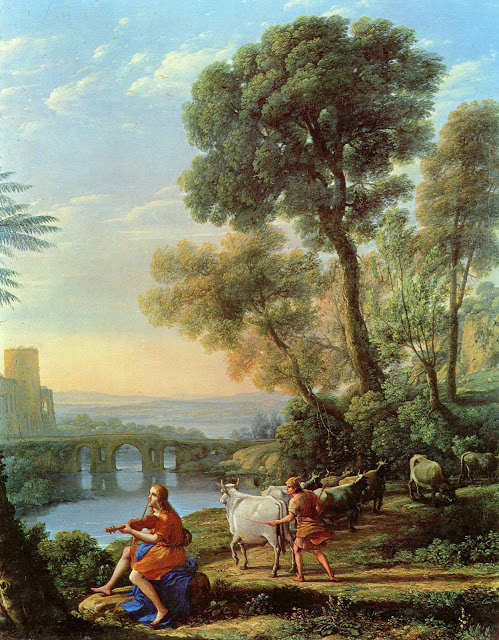
Claude Lorrain
Landscape with Apollo Guarding the Herds of Admetus and Mercury Stealing Them
circa 1645
55 cm × 45 cm
Location: Via del Corso, 305, 00186 Rome, Italy
Claude Lorrain
Landscape with Apollo Guarding the Herds of Admetus and Mercury Stealing Them
circa 1645
55 cm × 45 cm
Location: Via del Corso, 305, 00186 Rome, Italy
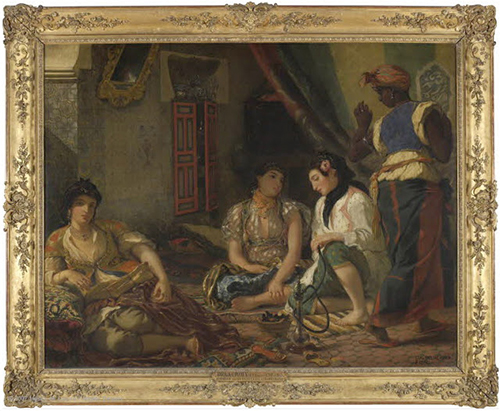
Eugène Delacroix (Charenton-Saint-Maurice (Val-de-Marne), 1798 – Paris, 1863)
Women of Algiers in Their Apartment
Salon of 1834
H. 1.80 m; W. 2.29 m
Acquired at the Salon of 1834
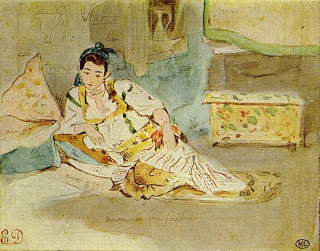

The Women of Algiers (2 studies) [ 1832 ] each 10cm × 13cm
Location: Louvre Museum, 75001 Paris, France
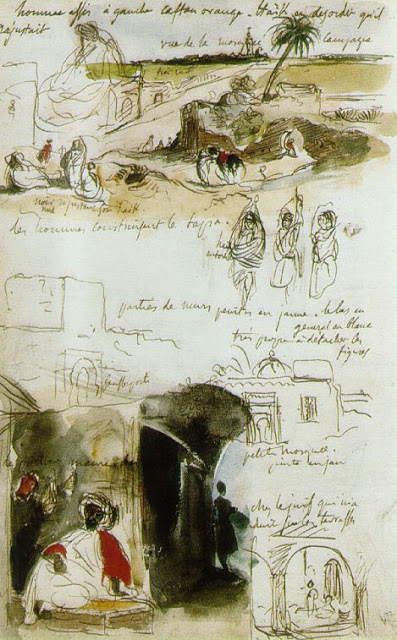
Eugene Delacroix
Moroccan notebook
1832
watercolor 19.3 x 12.7 cm
Location: Louvre Museum, 75001 Paris, France
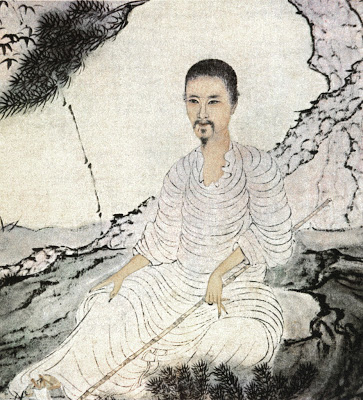
Shi Tao, Master Shi Planting Pines, c. 1674, ink and color on paper
Comments on painting Shi Tao :
One stroke method
(In the beginning there were no rules. When primeval naivete dispersed, rules took place. What were rules based upon? ONE,* the origin of beings, the base of changes, the power god applied, the ability man was endowed with but unaware of.**)
In the beginning there are no rules. When one’s naivete disperses, rules take place. What are rules based upon? ONE STROKE, the root of forms, the power the extraordinary applied, the ability the ordinary are endowed with but unaware of. How do rules take place? Awakening from within the self, one stroke grows into being and expands into rules.
Mountains, rivers and figures in riotous profusion; birds, beasts and plants of different character; water-side pavilions and towers of varying sizes – these are what painters take to heart. If a painter is unable to grasp the essence of form for a delicate expression, he must have been ignorant of this one stroke. As a journey begins with a single step, a painting, whatever it is about, begins with a single stroke; millions upon millions of brush strokes may follow, but it must end with one stroke, regardless of the when and why. If a painter takes such a stroke as the point of departure, he is unquestionably bound for success.
Without the wrist suspended the movement may not be free; without free movement the strokes may not be to one’s liking. Raise the wrist to be ready; turning the wrist to start; swing the wrist to finish a stroke. Push a stroke in checking motion; pull a stroke in lifting motion. Square-ended or round-ended, straight or curved, distorted or symmetric, tortuous or plain, wet or dry, brush strokes must be natural revelation. These rules, efficacious and time-tested, are the perfect avenues to the nature of forms and to the success of all expressions. Having chosen particular forms, pondered over and over for significance, decided the tone of a spectacle, gone over what in front and behind, with a single deft stroke, a painter produces vividly mountains, rivers, figures, birds, beasts, plants, water-side pavilions, or towers. Without any trace of affectation, such a stroke answers right his purpose.
When ONE STROKE takes place, all things can be defined. Therefore, I say, ?My doctrine is about one.?***
* Laozi, Way of Life, 42. Life, when it came to be, bore one. One bore two; two bore three; three bore all things.
** The Platform Sutra of Sixth Patriarch of Zen, Chapter One. He who sees from himself is the man, inspiration, Buddha.
*** The Analects of Confucius, Part Four. Master said, ?Sen, my doctrine is about one.? Disciple Zeng Sen replied, ?Yes.? When master was out, other disciples came up, asking, ?What do his words mean?? Zeng then said, ?His doctrine is about loyalty and forgiveness, that’s all.?
Location: National Palace Museum, Taipei, Taipei City, Taiwan 11143
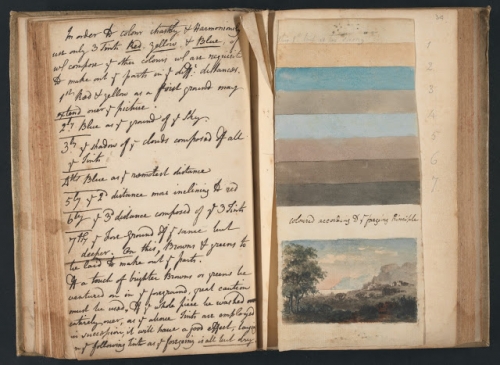
William Gilpin (1724-1804), Hints to form the taste & regulate ye judgment in sketching Landscape, ca. 1790, manuscript, in pen and ink, with watercolor, Yale Center for British Art, Paul Mellon Collection
Location: Yale Center For British Art, Yale University, 1080 Chapel Street, New Haven, CT 06510, USA
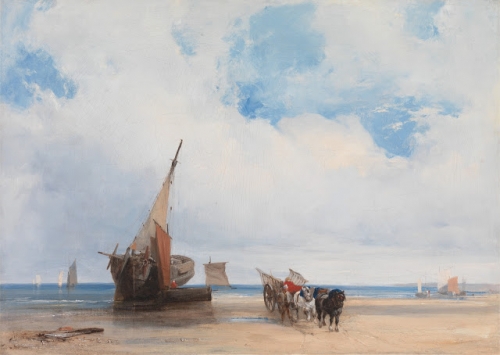
Richard Parkes Bonington 1802-1828
Beached Vessels and a Wagon, near Trouville, France
Oil on canvas ca. 1825
Dimensions 14 5/8 x 20 5/8 inches (37.1 x 52.4 cm)
Yale Center for British Art, Paul Mellon Collection Accession Number B1986.29.1

Richard Parkes Bonington
At the English Coast watercolour on paper 1825
w227 x h140 mm
Museum Of Fine Arts Budapest
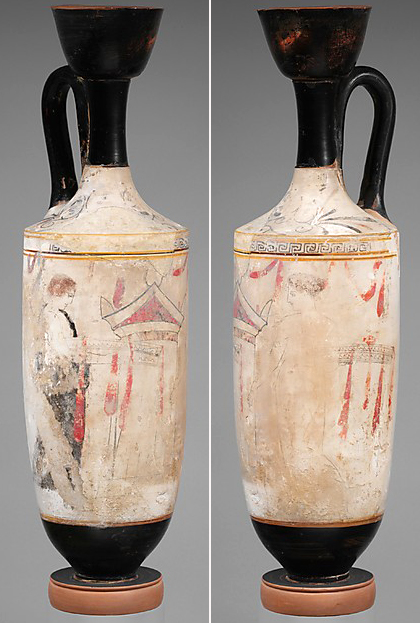
Terracotta lekythos (oil flask)
Attributed to the Painter of Berlin
ca. 420?410 B.C.
Terracotta: white-ground
Dimensions: H 16 1/4 in. (41.3 cm)
MMA New York NY
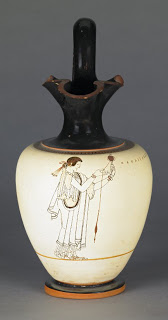
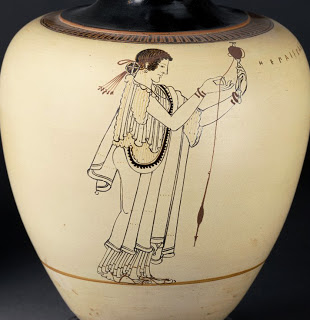
Pottery: White-ground oinochoe.
A woman in a long sleeved, dotted chiton, a bordered himation, and sandals, with earrings, bracelets, and hair wound into a ball on the neck and fastened with a fillet, standing to right, twisting between the thumb and first finger of her right hand a thread from a hank of wool on a distaff which she holds up with her left. On the right, HEΠAIΣ KAΛΕ, ή παΐς καλή. The neck, handle, and foot are glazed black; the surface of the neck is slightly raised above that of the shoulder. The edge of the lip is coloured purple; at the base of the handle is an inverted palmette below a strip of egg pattern, and below the moulding on the shoulder is a band of tongue pattern; all red on black. The body is covered with a white engobe, on which the design is drawn in black outline. Purple is used for fillet, bracelets, sandals, wool, and spindle. Light brown for inner markings and upper folds of chiton and inscription. The hair is drawn in dark brown lines on a wash of light brown. Eye archaic. Below, a thin brown line.
490BC-470BC (circa)
BM Registration number : 1873,0820.304
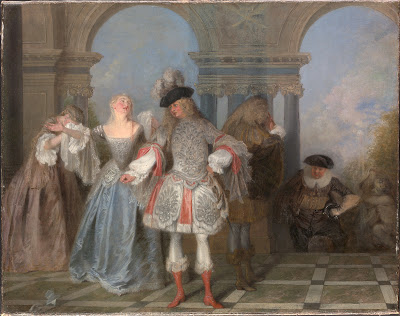
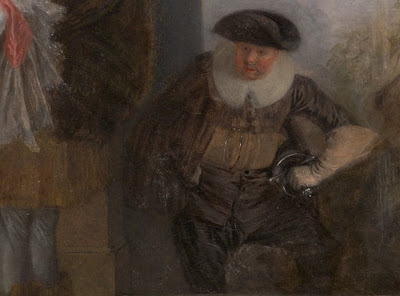
Antoine Watteau ( 1684?1721 )
The French Comedians 1720-1721 [ 22 1/2 x 28 3/4 in. (57.2 x 73 cm) ] with detail
MMA
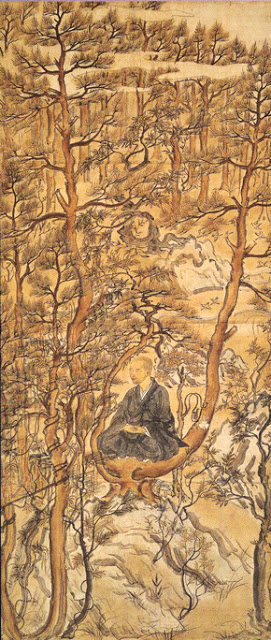
The Monk Myoe from Kozan-ji, Kyoto, dated to 13th Century Kamakura period
Hanging scroll 145.0 cm x 59.0 cm color on silk
Priests of Virtue in the Kamakura Period | special exhibition 1993 Nara National Museum
Location: Nara National Museum, Noboriojicho, Nara, Nara Prefecture 630-8213, Japan
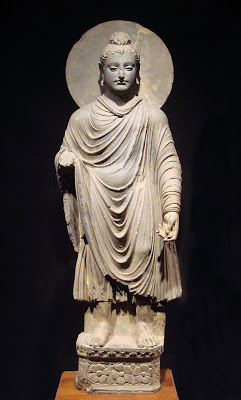
1st-2nd century CE
Location: Tokyo National Museum, 13-13-9 Uenokoen, Taito, Tokyo 110-0007, Japan
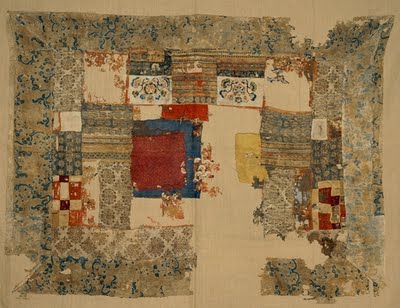
Patchwork of silk, probably a kasaya
From Cave 17, Mogao, near Dunhuang, Gansu province, China
Tang Dynasty, 8th-9th century AD
A Buddhist monastic robe : Height: 1070.000 mm : Width: 1490.000 mm
British Museum annotation :
Sir Marc Aurel Stein originally suggested that this large patchwork was an altar-cloth, though it has now been identified as a kasaya, a Buddhist monastic robe. The symmetrical arrangement of patches along a central vertical axis is consistent with the prescribed form for a kasaya. Even though these patches of cloth were originally meant as a sign of humility, a splendid array of silks has been used in this example.
The patchwork comprises seven vertical columns of fabric enclosed by a border of plain silk printed with blue foliated scrolls. Within the border are woven or printed silks with a rosette design. The dominating floral motif embroidered in the centre has largely disintegrated, revealing the silk patches used for strengthening. Only two small white panels of floral embroidery still remain intact.
The magnificence of the materials used and the presence of purple suggest that the wearer must have been a priest of high rank. Hong Bian (active in the mid-ninth century), the head priest who is commemorated in the cave where these textiles were found, had been given the right to wear purple by the emperor. Small pieces of purple silk were also found inside his statue.
M. Aurel Stein, Serindia: detailed report of e, 5 vols. (Oxford, 1921)
R. Whitfield, Art of Central Asia: The Stein, vol. 3 (Tokyo, Kodansha International Ltd., 1982-85)
R. Whitfield and A. Farrer, Caves of the thousand Buddhas: (London, The British Museum Press, 1990)
Location: The British Museum, Great Russell Street, London Borough of Camden, London WC1B 3DG, UK
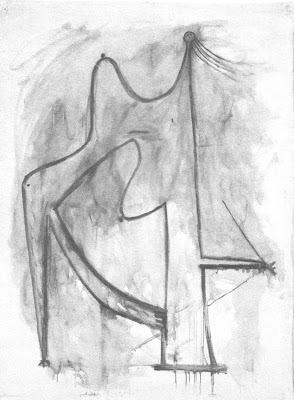
Standing Nude 1927 [ Collection Bernard Ruiz-Picasso ] 136 x 103 cm


top – Claude (1600-1682), Landscape with Jacob and Laban and his Daughters, 1654,
Petworth House, Sussex [ 1435 x 2515 mm ]
bottom – Joseph Mallord William Turner (1775‑1851), Appulia in Search of Appulus, vide Ovid, 1814,
Tate [ 1485 x 2410 mm ]